
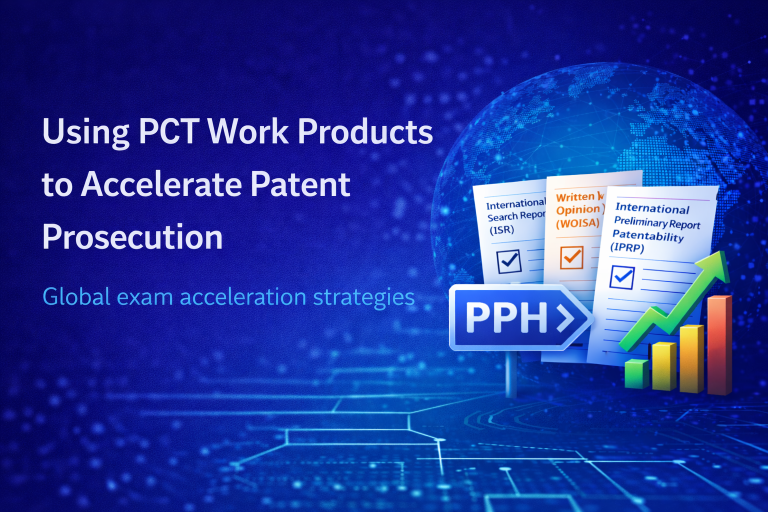
The international phase of a Patent Cooperation Treaty application is often misunderstood as a waiting period designed only to defer cost. In practice, the international phase generates legally persuasive work products that can materially compress prosecution timelines across multiple jurisdictions.
When used correctly, PCT work products convert time into leverage.
Strategic Leverage of the International Phase for Global Acceleration
PCT as a Compression Tool Rather Than a Deferral Tool
The international phase produces substantive examination outputs before national offices invest examination resources. This creates a unique opportunity to front-load patentability analysis and reuse it globally.
Acceleration is achieved not by speed alone, but by reducing examiner friction downstream.
Core PCT Work Products and Their Legal Significance
The principal PCT work products are:
· International Search Report (ISR)
· Written Opinion of the ISA (WOISA)
· International Preliminary Report on Patentability (IPRP), if Chapter II is invoked
These documents are non-binding but highly persuasive. Their legal weight increases when issued by established authorities such as the EPO or USPTO.
Using WOISA and IPRP to Trigger Patent Prosecution Highway (PPH)
Eligibility Conditions for PCT-PPH Requests
A PCT-PPH request typically requires:
- At least one claim found novel, inventive, and industrially applicable
- Issuance of WOISA or IPRP by a participating ISA or IPEA
- Sufficient claim correspondence between PCT and national claims
- A PPH agreement between the issuing authority and the national office
Eligibility is jurisdiction-specific and must be confirmed before entry.
Claim Correspondence and Scope Discipline
Claim correspondence is the most common failure point.
National claims must not exceed the scope of claims indicated as allowable internationally. Broader claims invalidate the PPH request.
This often requires pre-entry claim pruning.
Examiner Behaviour Under PPH Workflows
Under PPH, examiners do not conduct a de novo search. They validate peer findings.
Based on observed prosecution trends, this typically results in:
· Fewer office actions
· Higher allowance rates
· Reduced pendency
Acceleration Pathways in the Indian Patent Office
Rule 24C Expedited Examination Based on PCT Status
India does not participate in the Global PPH, but Rule 24C provides an alternative route.
Expedited examination is available where:
· India was selected as ISA or IPEA
· The applicant qualifies under additional Rule 24C categories
Form 18A must be filed with supporting evidence.
Strategic Selection of ISA for Indian Applicants
Selecting IPO as ISA offers:
· Lower search fees
· Eligibility for Rule 24C acceleration
· Alignment with Indian examination approach
This is particularly relevant for India-first commercial strategies.
Interaction Between PCT Work Products and Indian Examination Practice
While not binding, Indian examiners frequently rely on ISR citations as a baseline. Clean international records correlate strongly with smoother First Examination Reports.
Leveraging PCT Work Products in the USPTO and EPO
USPTO PCT-PPH Versus Track One Prioritised Examination
PCT-PPH in the US:
· No government fee
· Requires claim correspondence
· Slower than Track One but far cheaper
Track One offers speed but not examination deference.
EPO Entry Strategy Following EPO-ISA Searches
When EPO acts as ISA:
· International search replaces supplementary European search
· Rule 70(2) EPC can be waived
· Examination can commence immediately upon entry
This can eliminate several procedural months.
Procedural Shortcuts Enabled by Positive International Opinions
Positive international opinions enable:
· Early examination requests
· Waiver of procedural communications
· Streamlined prosecution sequencing
Tactical Use of Article 19 and Article 34 Amendments
Article 19 Claim Amendments for Publication-Stage Cleanup
Article 19 allows a single post-ISR claim amendment.
This is a public-facing cleanup tool, not an examination dialogue.
Chapter II Demand and Article 34 for IPRP Engineering
Article 34 permits:
· Claim, description, and drawing amendments
· Examiner engagement
· Issuance of IPRP Chapter II
This is the primary route to engineering a PPH-ready record.
Timing Risks and Estoppel Considerations
Unnecessary narrowing creates prosecution history estoppel, particularly in the US and Europe. Amend only where patentability requires it.
Comparative Analysis of Acceleration Mechanisms
PCT-PPH Versus Domestic Accelerated Examination Routes
|
Parameter |
PCT-PPH |
Domestic Acceleration |
|
Fee |
Usually nil |
Often substantial |
|
Examiner deference |
High |
None |
|
Claim flexibility |
Limited |
Broad |
|
Risk |
Lower |
Higher |
Cost, Speed, and Scope Trade-Offs
PCT-PPH optimises predictability. Domestic acceleration optimises speed.
Risk Management: Avoiding the Negative Record Trap
Consequences of Unaddressed Negative WOISA
Unaddressed WOISA objections become part of the public record and are routinely adopted by national examiners.
International File Wrapper Contamination Risks
National examiners frequently review the PCT file wrapper. Silence is interpreted as concession.
Operational Checklist for PCT-to-National Phase Acceleration
· Confirm PPH eligibility per jurisdiction
· Audit WOISA and IPRP status
· Align national claims before entry
· File PPH request before substantive examination
· Verify translation accuracy for claim correspondence
Frequently Asked Questions (FAQs)
Does a
positive WOISA guarantee grant?
No. It increases
probability, not certainty.
Can
India accept PPH from EPO?
No. Only JPO
under current pilots.
Is
Article 34 always preferable to Article 19?
For
acceleration, yes.
Can
rejected claims be pursued later?
Yes, via
divisional applications.