
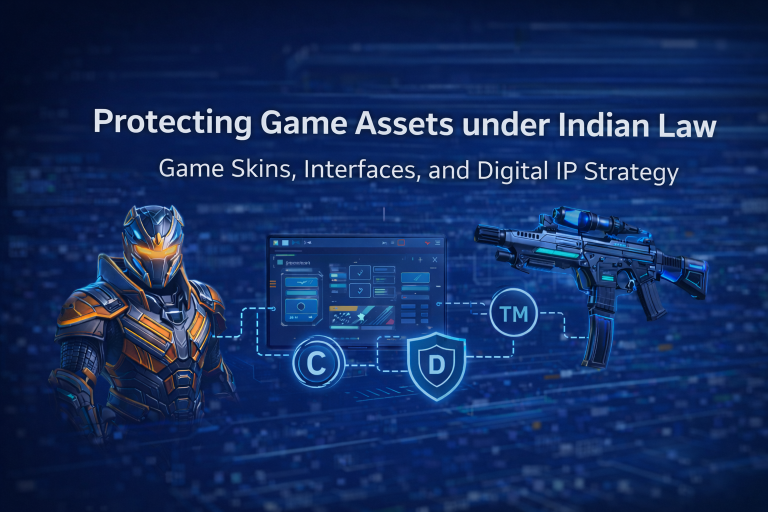
In the modern
gaming economy, visual assets generate more revenue than gameplay itself.
Character skins, weapon wraps, and interface themes form the core of
monetization in live service games.
Yet most studios rely only on copyright. In India, that is a structurally unsafe strategy.
This article explains how to protect game assets and structure enforceable design rights for skins using design law, copyright, trademark, and enforcement strategy.
The Regulatory Status of Game Assets and Virtual Skins under Indian Design Law
Section 2(a) and the Article Requirement for Digital and Virtual Goods
Section 2(a) of the Designs Act defines an article as any article of manufacture and any part capable of being made and sold separately.
Historically, the Indian Patent Office required:
· Physical articles
· Tangible movable goods
Based on current IPO practice in 2025 and 2026, digital assets are accepted only if:
· Shown as applied to a display device
· Presented as part of a hardware interface
· Framed as visual features of an article
Standalone texture files or abstract meshes are routinely objected.
Locarno Classification for Game Skins, GUIs, and Surface Ornamentation
Post 2021, the following classes are used:
· Class 14 04 for screen displays and icons
· Class 32 for surface patterns and ornamentation
Weapon skins fall under Class 32. Character skins and GUIs fall under Class 14 04.
Multi class strategies are increasingly used for seasonal releases.
Judicial Evolution on Digital
Designs and Virtual Articles
Following the Calcutta High Court GUI remand and later High Court observations, subject to examiner interpretation, digital designs are now examined based on:
· Visual appeal
· Commercial value
· Application to hardware
Virtual goods
are not excluded per se.
They are constrained by drafting.
Copyright and Design Overlap in Game Assets under Section 15(2)
Character Skins as Artistic Works at the Creation Stage
At creation, skins are artistic works. Copyright arises automatically.
This protects:
· Concept art
· Textures
· 3D meshes
The Fifty Copy Rule and Automatic Cessation of Copyright
Section 15(2) provides:
If a design capable of registration is reproduced more than fifty times by an industrial process and is not registered, copyright ceases.
For game skins:
· Every sale is a reproduction
· Every mint is a reproduction
High volume skins lose copyright protection.
Defensive Design Filings to Prevent Public Domain Loss
Legendary and monetized skins must be registered before scale.
Failure results in:
· No copyright
· No design
· No enforceable rights
Design Registration Strategy for Game Skins and UI Assets in India
Registrability of Digital Skins under the Designs Act, 2000
Registrable assets include:
· Character costumes
· Weapon wraps
· Vehicle skins
· Interface layouts
They must:
· Appeal to the eye
· Be novel
· Be non functional
Drafting Representations for 2D, 3D, and Animated Skins
Representations should include:
· Perspective view
· Orthographic views
· Dotted lines for unclaimed parts
· Clear novelty statement
Animated skins require multiple static filings.
Novelty Risks in Betas, Trailers, and Early Access Releases
India has absolute novelty.
Novelty is destroyed by:
· Trailers
· Twitch streams
· Beta screenshots
· Early access launches
File before any public reveal.
Trademark and Trade Dress Protection for In Game Visual Identity
Skins as Source Identifiers and Brand Signals
Iconic skins may function as trademarks if:
· Used consistently
· Identified with the studio
· Distinctive over time
Trade Dress Protection for Game Worlds and Marketplaces
Trade dress can protect:
· Overall UI identity
· Store layouts
· Menu structures
Secondary Meaning in Iconic and Legendary Skins
Secondary meaning arises through:
· Long term use
· Player association
· Market recognition
This enables passing off actions.
Global Filing Strategy for Digital Game Designs
USPTO Design Patents for Game Interfaces and Skins
The US allows:
· Partial designs
· Animated sequences
· Broad GUI protection
EUIPO Community Designs and Unregistered Design Rights
EUIPO provides:
· Fast registration
· Multiple applications
· Three year unregistered protection
CNIPA Partial Design Regime for Game Assets
China permits:
· Partial designs
· Standalone GUIs
· Strong enforcement
Enforcement Strategy against Asset Ripping and Digital Cloning
Identifying Design Infringement in Games and Marketplaces
Infringement occurs through:
· Clone games
· Asset ripping
· Mod resales
· Private servers
Visual similarity controls liability.
Platform Take Down Mechanisms under IT Rules 2021
Registered designs enable:
· App store take downs
· Hosting notices
· Marketplace removals
Civil Remedies against Private Servers and Clone Games
Remedies include:
· Injunctions
· Seizure orders
· Account blocking
· Damages
Portfolio Structuring and Business Strategy for Game Studios
Layered Protection for Flagship and Revenue Skins
Best practice uses:
· Design registration
· Copyright
· Trademark
Partial Design Strategy for Modular Game Assets
Protect:
· Helmets
· Armor
· Weapon components
Cost and Filing Sequencing for Indie and AAA Studios
Indie
studios file selectively.
AAA studios build design thickets.
Implementation Framework for Studios and Creators
Pre Release IP Audit Checklist for Skins and UI Assets
· Confirm novelty
· Secure assignments
· File before reveal
· Identify flagship assets
Drafting Asset Development and Assignment Agreements
Agreements must include:
· Copyright assignment
· Design rights assignment
· Confidentiality
Monitoring and Surveillance Protocol for Skin Piracy
Implement:
· Marketplace monitoring
· Image search tools
· Player reporting
Frequently asked questions (FAQs)
Can game skins be registered as designs in India
Yes, if applied to a device and visually ornamental.
Does copyright alone protect skins
No. Section 15(2) destroys copyright after scale.
Can animated skins be protected
Yes, through multiple design filings.
Is trade dress useful for skins
Only for iconic skins with secondary meaning.
Does beta testing destroy novelty
Yes, if public.
Should indie studios file designs
Only for revenue generating skins.
Can partial skins be protected
Yes, through partial design strategy.
Are NFTs relevant for IP protection
No. NFTs do not create IP rights.
How fast are take downs
Typically 36 to 72 hours.
How long do suits take
Final resolution takes 18 to 36 months.