
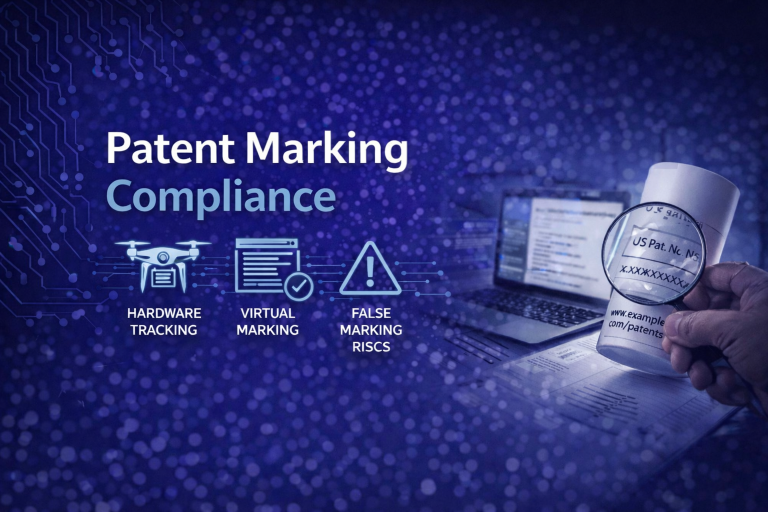
Patent marking is a compliance mechanism that directly affects enforcement outcomes, damages recovery, and litigation leverage. It is not a cosmetic labeling exercise. In many jurisdictions, including India and the United States, the presence or absence of patent marking materially influences the availability of monetary remedies and the strength of infringement claims.
For in-house counsel, patent marking sits at the intersection of legal compliance, product operations, and enforcement readiness. The choice between physical marking and virtual patent marking must be deliberate, jurisdiction-specific, and aligned with portfolio scale and product lifecycle realities.
Legal Foundation and Statutory Provisions for Patent Marking
Section 111 of the Indian Patents Act: Damage Limitation and Constructive Notice
Section 111 of the Indian Patents Act, 1970 governs the consequences of failure to mark patented products.
If a defendant establishes that they were not aware and had no reasonable grounds to believe that a patent existed at the time of infringement, the court may refuse damages or an account of profits. Injunctive relief may still be granted, but financial recovery is curtailed.
The statutory logic is constructive notice. Marking operates as a public signal that the product is protected. Merely stating “Patented” without identifying the patent number is generally insufficient to establish constructive notice.
Based on current Indian litigation practice, while marking is not mandatory to initiate infringement proceedings, it is critical for recovering pre-suit damages.
Comparative Analysis: 35 U.S.C. § 287(a) and the AIA Framework
In the United States, patent marking is governed by 35 U.S.C. § 287(a). Failure to mark patented articles limits damages to the period after actual notice of infringement.
The America Invents Act formally introduced virtual patent marking. Instead of listing patent numbers on the product, the patentee may provide a URL that associates products with relevant patents.
This framework allows real-time updates as patents issue or expire, without retooling physical molds or packaging. Courts treat compliant virtual marking as legally equivalent to physical marking for constructive notice purposes.
The Burden of Proof: Notice vs Innocent Infringement Defense
Proper marking shifts the evidentiary burden to the infringer. Once constructive notice is established, defendants cannot rely on innocent infringement defenses to limit damages.
In the absence of marking, the patentee must prove actual notice, typically through cease-and-desist correspondence or service of a complaint. This restricts recoverable damages to a later time window.
From an enforcement strategy perspective, marking preserves the full damages horizon.
Physical Marking Standards and Technical Constraints
Criteria for Fixed vs Package Marking in Hardware and UAVs
Physical marking involves engraving, stamping, etching, or printing patent information directly on the patented article.
Courts generally prefer fixed marking on the product itself. For UAVs or hardware systems, this may include a laser-etched plate on the chassis or structural component.
Package marking is acceptable only when physical marking is impractical due to size, material, or functionality constraints. If fixed marking was feasible but omitted, courts may find notice inadequate.
Language and Formatting Requirements for International Enforcement
Patent marking must conform to jurisdictional conventions.
In the United
States, formats such as “US Pat. No. XXXXXXX” are standard.
In India, “Indian Patent No. XXXXX” is commonly used.
In Europe, requirements vary by member state, but clarity and accuracy remain
essential.
Incorrect formatting does not automatically invalidate marking, but ambiguity weakens evidentiary value.
Risks of False Marking: Penal Provisions and Regulatory Penalties
False marking occurs when products are marked with expired patents, inapplicable patents, or misleading representations.
In India, Section 120 of the Patents Act prescribes penalties for falsely representing that an article is patented. In the US, false marking can expose the patentee to unfair competition claims and reputational harm.
Regular audits are essential to ensure expired or irrelevant patents are removed from markings.
Operationalizing Virtual Patent Marking (VPM)
Statutory Validity of Virtual Links in Global Jurisdictions
Virtual patent marking is expressly recognized under US law. While Indian law does not explicitly reference virtual marking, courts increasingly accept digital notice mechanisms when supported by credible records.
Based on current practice, a clearly accessible URL that maps products to patent numbers is likely to satisfy constructive notice expectations in India, particularly in commercial disputes.
Best Practices for Maintaining a Dynamic VPM Webpage
A compliant VPM system must meet specific operational standards.
The webpage must be publicly accessible without authentication. It must clearly associate each product with the applicable patent numbers. Listing all patents without product mapping is insufficient.
The URL referenced on the product must remain stable for the life of the patent. Broken or redirected links undermine notice.
Checklist: Compliance Parameters for a Defensible VPM System
1. Publicly accessible URL without login requirements
2. Clear product-to-patent mapping
3. Updates within 48 hours of patent grant or lapse
4. Archived records of prior versions
5. Separation of expired patents into a legacy section
Strategic Integration in Drone and Defense Tech
Marking Challenges in Component-Level vs System-Level Patents
Drone systems often involve multiple patented subsystems.
System-level patents should be marked on the primary chassis or controller. Component-level patents may require marking on individual components, particularly when supplied by third-party manufacturers.
Licensing agreements should explicitly allocate marking responsibility.
Export Control and Secrecy Direction (Section 35) Marking Conflicts
Where inventions are subject to secrecy directions under Section 35 of the Indian Patents Act, public disclosure through marking may be prohibited.
Marking secret patents on export-controlled hardware can create regulatory violations. Coordination with export control and defense authorities is essential.
Managing Marking for Licensing and Sub-Assembly Partnerships
If patented technology is licensed to an OEM, the license agreement must mandate marking compliance.
Failure by a licensee to mark can deprive the patentee of damages against third-party infringers, even when infringement is proven.
Enforcement Dynamics: Impact on Damages and Royalties
Pre-Suit Notice Requirements and the Role of Marking in Quantifying Damages
Marking determines when damages begin to accrue.
Without marking, damages typically accrue only after actual notice. With proper marking, damages may accrue from the start of infringement, subject to statutory limitation periods.
In high-value technology sectors, the difference can be commercially significant.
Strategic Transition: Moving from Physical to Virtual Marking in Growth Startups
Early-stage companies often rely on informal marking practices.
As portfolios scale, transitioning to virtual marking reduces operational friction and compliance risk. QR codes or URLs can bridge early-stage constraints while preserving enforceability.
Frequently asked questions (FAQs)
Does
“Patent Pending” provide constructive notice?
No. Patent
pending does not enable damages recovery.
Can QR codes be used for virtual marking?
Yes, if they link directly to the patent mapping page.
What
if one production batch is unmarked?
Substantial
compliance is evaluated. Isolated lapses may not be fatal but create risk.
Is software subject to marking?
Yes. Marking should appear in UI legal or about sections.
Are
services marked differently?
Yes. Marking
appears on service documentation or delivery interfaces.
Is
virtual marking accepted in China?
Digital notice
is evolving, but physical marking remains advisable for enforcement.
Should
patent application numbers be marked?
They may be
marked as pending, but do not trigger damages benefits.
Can
incorrect VPM pages create liability?
Yes. Misleading
representations can lead to unfair competition claims.
Does
marking apply to design registrations?
Yes. Proper
marking strengthens damages claims under design law.
What
is the best URL structure for VPM?
A stable,
dedicated path such as company.com/patents is recommended.