
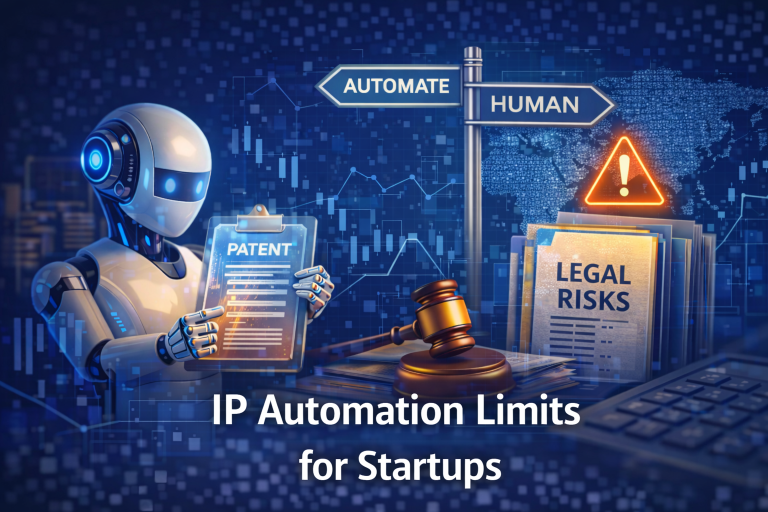
Early-stage companies in 2025–2026 face a structural tension in intellectual property strategy. On one side is the need for speed, experimentation, and capital efficiency. On the other is the irreversible nature of IP mistakes. Once a deadline is missed, a claim is poorly drafted, or an eligibility position is conceded, the error compounds across jurisdictions and funding rounds.
The question is no longer whether startups should automate IP tasks. The real question is which tasks can be automated without creating downstream legal risk, and which tasks must remain human-led even if that increases short-term cost.
This article sets out a practical boundary line between automation, DIY workflows, and full-service professional involvement, grounded in current Indian, US, and European practice.
The Economic Logic of IP Automation in the Startup Lifecycle
Automation in IP should be evaluated through unit economics, not ideology. The goal is not to replace professionals, but to reduce friction in repeatable, low-variance processes.
Unit Economics of Intellectual Property Spend
From a cost-optimization perspective, IP spend breaks into three categories:
· Clerical and administrative
· Analytical but repeatable
· Strategic and irreversible
Only the first two categories are suitable for automation.
Automating clerical functions lowers the cost per maintained asset. Automating analytical screening improves decision velocity. Attempting to automate strategic judgment usually increases long-term cost.
Capital Allocation and Timing Risk
Startups operate under capital asymmetry. Spending ₹3–5 lakhs too early on premium drafting can be inefficient. Spending ₹30,000 too late on professional review can be catastrophic.
Automation works best when it:
· Front-loads information gathering
· Back-loads professional validation
Scalability and Legal Technical Debt
DIY filings often introduce legal technical debt:
· Inconsistent terminology
· Narrow claim anchoring
· Unsupported embodiments
· Missed foreign filing logic
This debt rarely appears until diligence, licensing, or enforcement. By then, remediation costs exceed original savings.
Identifying Automatable IP Tasks (Low Risk, High Efficiency)
Automation is safest where errors are reversible and legal discretion is minimal.
Trademark Monitoring and Preliminary Clearance
Automated trademark tools can reliably:
· Scan registries
· Track similar marks
· Flag phonetic or visual conflicts
However:
· Final registrability opinions
· Risk assessment under Section 11
· Enforcement strategy
must remain attorney-led.
Prior Art Screening and Landscape Pre-Filtering
AI-assisted searches are effective for:
· Early novelty screening
· R&D direction decisions
· Competitive awareness
They are not substitutes for:
· Freedom-to-Operate opinions
· Validity analysis
· Litigation-grade searches
Deadline Management and Docketing
This is the highest ROI automation zone.
Automated docketing systems reliably:
· Track PCT, Paris, and national deadlines
· Monitor renewal windows
· Sync with patent office databases
Missing deadlines is a zero-tolerance error. Automation here reduces existential risk.
Automated IP Reporting for Investors
Automation is well suited for:
· Portfolio summaries
· Family trees
· Status dashboards
· Cost forecasts
This improves transparency during fundraising without legal risk.
The DIY Ceiling — Where Automation Becomes Dangerous
There is a clear ceiling beyond which DIY workflows degrade patent quality and enforceability.
Invention Disclosure Capture vs Claim Drafting
Automation is effective for:
· Capturing inventor inputs
· Structuring disclosures
· Summarizing embodiments
It fails at:
· Claim scope design
· Fallback positioning
· Language calibrated for infringement analysis
Claims are legal instruments, not technical descriptions.
Indian Exclusions under Section 3(k) and 3(i)
Indian patentability hinges on how an invention is characterized.
Automated tools struggle with:
· Reframing software as technical contribution
· Avoiding “per se” characterization
· Drafting around medical method exclusions
Based on current IPO examination practice, these areas require experienced human drafting.
Office Action Responses and Prosecution History Risk
Office Actions are negotiations.
Automation can:
· Summarize objections
· Suggest template amendments
It cannot:
· Anticipate estoppel effects
· Align amendments with enforcement strategy
· Read examiner intent across jurisdictions
Poor automated responses permanently narrow rights.
Patent Eligibility and AI-Related Claims (2025–2026)
Recent USPTO guidance emphasizes practical application for AI inventions. Aligning specifications with this evolving framework requires contextual judgment that current automation cannot reliably perform.
Legal and Technical Frameworks for AI-Assisted IP Workflows
Using automation introduces compliance obligations, not just efficiency gains.
Data Protection and Confidentiality (India, 2026)
Any IP tool processing inventor data must comply with Indian data protection law.
Key risks:
· Model training on user data
· Cross-border data transfers
· Lack of clear data processing agreements
Non-compliance creates regulatory exposure independent of IP outcomes.
Duty of Candor and AI Disclosure
Both Indian and US practice increasingly expect transparency where AI materially assists drafting.
Risk arises if:
· AI contributions are concealed
· Human review is not documented
· Inventorship boundaries are blurred
Human Conception and Inventorship Integrity
Current law remains clear:
· Inventors must be natural persons
· AI may assist but not conceive
Startups must maintain records showing human control over inventive decisions.
Decision Matrix — Automate vs Outsource vs In-House
Cost and Risk Comparison Table
|
Task |
Automation |
Full Service |
Recommended Approach |
|
Trademark screening |
Low cost |
Moderate |
Automate + legal review |
|
Docketing |
Very low |
High |
Fully automate |
|
Provisional drafts |
Low |
Moderate |
Draft internally, file professionally |
|
Office Actions |
Limited |
High |
Professional handling |
|
FTO opinions |
Insufficient |
High |
Full service only |
Risk Assessment Checklist for DIY Tools
· Does the tool retain or train on your data?
· Does it support jurisdiction-specific rules?
· Is there an audit trail of human edits?
· Are confidentiality obligations contractually clear?
If any answer is unclear, automation should stop.
When to Pivot Away from DIY
Pivot when:
· External funding begins
· Cross-border filings start
· Licensing or enforcement is contemplated
· Core product features are patented
Integration with Global Filing Strategy
Automated Portals for International Coordination
Automation helps manage:
· Translation workflows
· Agent coordination
· Cost aggregation
But jurisdiction-specific claim localization must remain professional.
Subject Matter Divergence Across Jurisdictions
An AI-drafted US-centric application often fails in:
· India under Section 3(k)
· Europe under Article 52 EPC
Human localization is essential.
Frequently asked questions (FAQs)
Q: Can AI be listed as an inventor?
No. Inventors must be natural persons.
Q: Is using ChatGPT for patent drafting safe?
Not without enterprise isolation and legal oversight.
Q: Can automation replace FTO opinions?
No. Searches can be automated. Legal conclusions cannot.
Q:
Does automation reduce official filing fees?
No. Fee reductions depend on entity status, not tools.
Q: When does
full-service become unavoidable?
At the point of
enforcement, licensing, or multi-country strategy.