
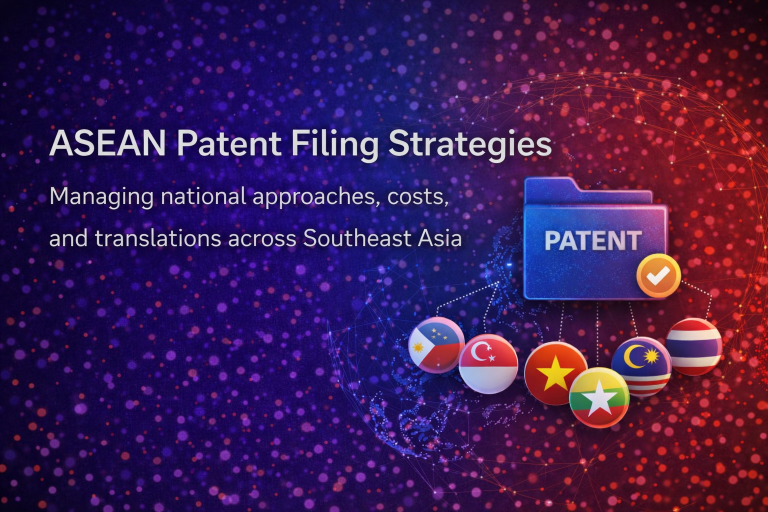
ASEAN is one of the most commercially important and legally fragmented patent regions in the world. It represents more than 650 million consumers and a rapidly expanding manufacturing base, yet it offers no regional patent system, no central examination, and no unified enforcement framework.
For Indian and international applicants, ASEAN filing is not a single strategy. It is a collection of ten independent national strategies that must be coordinated carefully with:
· Priority timing
· Translation planning
· Manufacturing geography
· Enforcement feasibility
A correct ASEAN strategy is defined less by where revenue is earned and more by where products are manufactured, imported, and first commercialized.
ASEAN Patent Landscape: Fragmentation vs. Harmonization
The Myth of the ASEAN Patent
There is no ASEAN community patent. Protection in Southeast Asia is obtained only through separate national filings in each target jurisdiction.
Each country requires:
· Separate application
· Separate prosecution
· Separate grant
· Separate renewal
· Separate enforcement
A patent granted in Singapore has no legal effect in Thailand, Vietnam, or Indonesia.
This fragmentation multiplies:
· Translation costs
· Deadline risks
· Prosecution divergence
· Litigation complexity
ASPEC and Work Sharing in ASEAN
The only meaningful regional coordination mechanism is ASPEC, the ASEAN Patent Examination Cooperation program.
ASPEC allows an examiner in one ASEAN office to consider the search and examination results issued by another ASEAN office.
Based on current practice:
· Singapore is the preferred Reference Office
· Thailand, Vietnam, and Indonesia commonly act as Second Offices
Strategic use:
· File first in Singapore
· Obtain a favorable IPOS examination report
· Submit that report under ASPEC in slower offices
ASPEC does not bind national examiners, but it reduces:
· Redundant searches
· Inconsistent objections
· Attorney cycles
Jurisdictional Tiers in ASEAN
For strategy and budgeting, ASEAN can be divided into three tiers.
Tier 1
· Singapore
Tier 2
· Malaysia
· Thailand
· Vietnam
· Indonesia
· Philippines
Tier 3
· Cambodia
· Laos
· Brunei
· Myanmar
Tier 3 jurisdictions often rely on:
· Re registration
· Form based examination
· Limited substantive review
Myanmar is currently transitioning to a full examination system following the enforcement of its Patent Law in 2024.
Filing Routes and Strategic Entry Points
PCT National Phase as the Default Route
All major ASEAN economies are PCT members.
National phase deadlines:
· 30 months: Singapore, Thailand, Vietnam, Malaysia, Philippines, Cambodia, Laos
· 31 months: Indonesia
The PCT route is preferred because it:
· Defers translation cost
· Allows claim shaping using ISR and IPRP
· Aligns ASEAN entry with US, China, and Europe
For most portfolios, Paris direct filing in ASEAN is inefficient.
Singapore as a Procedural Hub
Singapore plays a dual role.
First, it is a high quality examination office.
Second, a granted Singapore patent can be re registered in:
· Cambodia
· Laos
This makes a Singapore filing strategically valuable even when:
· The Singapore market is small
· Manufacturing is elsewhere
Singapore programs such as SG IP FAST allow grants in six to nine months.
When Direct Paris Filings Are Justified
Direct Paris filings are justified only when:
· Only Singapore and Malaysia are targeted
· Myanmar transitional filings are required
· Extreme speed is required
For broad ASEAN coverage, Paris filings multiply translation cost too early.
Critical Formalities and Procedural Traps
Translation as the Primary Risk Driver
Full translation is mandatory in:
· Thailand
· Vietnam
· Indonesia
Translation errors frequently cause:
· Indefiniteness objections
· Added matter violations
· Unenforceable claims
Poor translation is one of the most common causes of weak ASEAN patents.
Foreign Filing License Requirements in ASEAN
Local security clearance rules apply when inventors are residents.
Examples:
· Singapore requires filing first or written permission
· Malaysia imposes resident filing restrictions
· Vietnam requires first filing in Vietnam for security related inventions
Failure to comply can lead to:
· Criminal liability
· Patent invalidation
Power of Attorney and Legalization
Many ASEAN offices require:
· Notarized PoA
· Apostille or legalization
· Wet ink signatures
Failure to comply leads to abandonment in several jurisdictions.
Substantive Patentability in Key ASEAN States
Software and Computer Implemented Inventions
Most ASEAN offices exclude:
· Pure software
· Business methods
· Signals and data structures
Singapore and Malaysia allow software patents only when:
· Technical contribution is demonstrated
· System architecture is emphasized
Vietnam and Thailand are stricter.
Pharmaceutical and Biotech Standards
Thailand and Vietnam apply strict scrutiny to:
· New use claims
· Polymorph claims
· Formulation claims
Evergreening is actively resisted.
Indonesia and Simple Patents
Indonesia offers Simple Patents for:
· Products only
· Lower inventive step
This is useful for:
· Mechanical improvements
· Consumer hardware
Cost Control and Portfolio Design
Filing and Prosecution Cost Ranges
Indicative first stage costs:
· Singapore: USD 3,000 to 5,000
· Thailand: USD 4,000 to 7,000
· Vietnam: USD 4,000 to 7,000
· Indonesia: USD 5,000 to 8,000
Translation often exceeds official fees.
Pruning Strategy in ASEAN
After grant:
· Drop low revenue markets early
· Retain manufacturing control states
· Concentrate renewals in Singapore and Indonesia
Renewal and Back Annuity Risks
Indonesia often requires:
· Lump sum back annuities at grant
Vietnam and Thailand calculate annuities retrospectively.
Enforcement and Risk Management
Court Quality and Injunction Practice
High reliability:
· Singapore
Moderate reliability:
· Malaysia
· Thailand
Low predictability:
· Indonesia
· Vietnam
Border Control and Customs
Effective mainly in:
· Singapore
· Thailand
Weak for technically complex patents.
Criminal Enforcement
Primarily relevant for:
· Trademarks
· Design piracy
Rare for patents.
Decision Framework: When ASEAN Filings Add Real Value
Manufacturing Driven Filings
Protect:
· Vietnam
· Indonesia
· Thailand
Market Driven Filings
Protect:
· Singapore
· Thailand
· Philippines
Sector Specific Guidance
Electronics: Singapore, Vietnam,
Indonesia
Pharma: Singapore, Thailand, Malaysia
Software: Singapore primarily
Filing Checklists and Risk Flags
Pre Filing Checklist
· Priority confirmed
· Translation plan finalized
· Local counsel engaged
· PCT work product reviewed
Drafting Do’s and Don’ts
Do:
· Draft system claims
· Avoid pure method claims
Do not:
· Rely on US claim formats
· Ignore translation review
Red Flags
· Late translations
· Missing notarization
· Inconsistent inventor data
Frequently Asked Questions (FAQs)
Is
there an ASEAN patent
No
Is
Singapore alone sufficient
Rarely
Is PCT
preferred
Yes
Is
enforcement uniform
No
Is
translation critical
Yes
Is
pruning easy
Yes after grant
Are
utility models useful
Yes in many ASEAN states