
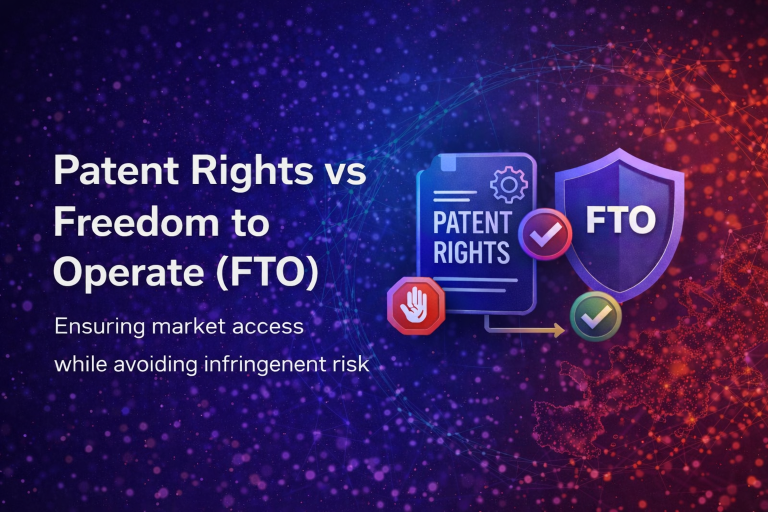
In the high-stakes environment of global commercialization, a common and dangerous misconception prevails: that obtaining a patent grant equates to a "green light" for market entry. Legally and strategically, this is incorrect. A patent is a defensive right—a "negative right", to exclude others, not an affirmative right to practice your own invention. For Indian founders, in-house counsel, and international investors, failing to distinguish between patentability and Freedom to Operate (FTO) often leads to catastrophic litigation, forced redesigns, or complete market withdrawal shortly after a high-profile launch.
The Legal Dichotomy: Patent Rights vs. Freedom to Operate
Understanding the structural difference between these two concepts is the first step in building a resilient global IP strategy.
The Negative Right Principle
Under Section 48 of the Indian Patents Act, 1970 (and similarly under 35 U.S.C. § 154 in the US and Article 64 of the EPC), a patent grant confers the exclusive right to prevent third parties from making, using, selling, or importing the patented invention. It does not grant the patentee the right to infringe upon the pre-existing, broader patents of others.
Cumulative Innovation and the "Blocking Patent" Scenario
Most modern inventions are incremental improvements or combinations of existing technologies. While your specific improvement may be novel and non-obvious (meriting a patent), the commercialized version of your product likely incorporates base components or processes still covered by active third-party patents.
· The "Chair" Example: If a third party holds a broad patent for "a seating apparatus with four legs and a backrest," and you invent an "ergonomic lumbar-support attachment for a chair," you may get a patent for the attachment. However, you cannot sell a chair featuring your attachment without a license from the original patent holder.
The Architecture of a Global FTO Analysis
A Freedom to Operate analysis (also known as a clearance search) is a forward-looking risk assessment that differs fundamentally from the novelty searches conducted by Patent Office examiners.
Search Parameters: Beyond Novelty
While a patentability search looks at "prior art" (anything published globally at any time), an FTO search is narrower in time but deeper in claim analysis.
· Jurisdictional Focus: FTO is strictly territorial. A search for a product launch in India focuses only on in-force Indian patents, even if the technology is "free" in the US.
· Temporal Scope: FTO focuses only on "live" patents (typically those filed within the last 20 years) and pending applications that could mature into blocking rights.
· Claim-Centric Review: Examiners check if your invention is different from others. FTO attorneys check if your product falls within the literal or equivalent scope of third-party claims.
Elements of an FTO Opinion
A professional FTO opinion provides a categorized risk matrix:
· Low Risk: No relevant patents found; technology appears to be in the public domain.
· Moderate Risk: Expired patents found (safe to use) or pending applications with uncertain claim scope.
· High Risk: Active "blocking patents" identified where your product meets all elements of at least one independent claim.
Decision-Making: When to Invest in FTO
Not every product iteration requires a full-scale global FTO. Strategic allocation of resources is essential for startups and MNCs alike.
Strategic Triggers for FTO
· Product Launch / Market Entry: Mandatory before entering a major new jurisdiction (e.g., India, US, or China).
· Significant R&D Investment: Before freezing a design that will cost millions to manufacture.
· Due Diligence (M&A/Funding): Investors in 2026 rarely settle for a "patent grant" alone; they demand proof of clearance to ensure their capital isn't funding a future lawsuit.
Comparative Framework: FTO vs. Patentability
|
Feature |
Patentability (Novelty) Search |
Freedom to Operate (FTO) Search |
|
Primary Goal |
Can I get a patent? |
Can I sell my product? |
|
Legal Basis |
Novelty & Inventive Step |
Infringement (Claims vs. Product) |
|
Search Scope |
Worldwide, all time (including books) |
Jurisdiction-specific, last 20 years |
|
Status of Result |
Validates ownership |
Validates market access |
|
Standard Cost |
Lower (Automated/Database focus) |
Higher (Legal/Claim analysis focus) |
Strategic Responses to Blocking Patents
Identifying a risk early is an advantage, not a dead end. Once a blocking patent is identified, the IP professional has several strategic levers.
1. Design-Around Strategy
This is the most common proactive move. By modifying a single element of a product so that it no longer "reads on" a specific patent claim, a company can bypass the infringement risk entirely.
· Tactical Tip: Involve patent counsel early in the R&D cycle to provide "boundaries" within which the engineering team can safely innovate.
2. Licensing and Cross-Licensing
If a patent is essential and cannot be designed around, a license provides legal certainty. In mature industries like telecommunications, cross-licensing (where both parties trade rights to their respective portfolios) is the standard method for maintaining FTO.
3. Invalidation Actions (The "Sword" Strategy)
If a blocking patent is identified but appears weak (e.g., lacking novelty based on obscure prior art), the applicant may choose to proactively challenge the patent via:
· Pre-grant/Post-grant Opposition: In India (Sections 25(1) and 25(2)).
· Inter Partes Review (IPR): In the USPTO.
· Central Revocation: In the European Unified Patent Court (UPC).
Checklist: Managing Global Risk Post-Grant
· Map Product to Claims: Ensure the actual commercialized product (not just the patent draft) is mapped against the claims of competitors.
· Monitor "Deadly" Pendency: Track pending applications of competitors that could grant with broad claims after your launch.
· Jurisdictional Divergence: Recognize that FTO in India does not guarantee FTO in the US; separate clearances are required for each primary market.
· Attorney-Client Privilege: Ensure FTO opinions are conducted through counsel to maintain privilege, protecting the company from "willful infringement" claims if a lawsuit eventually occurs.
Frequently asked questions (FAQs)
1. If the Patent Office granted my patent, doesn't that mean I'm not infringing others?
No. The Patent Office only checks if your invention is a "new" improvement. They do not check if your "new" product also happens to use a "old" patented component from someone else.
2. Can an FTO search guarantee I won't be sued?
No. An FTO is a risk assessment, not a guarantee. There is always a risk of "submarine patents" (applications published after your search) or different judicial interpretations of claim language.
3. Is FTO necessary for software and SaaS products?
Yes, especially in the US and Europe. Software patents often cover broad functional "methods" that your SaaS architecture might inadvertently implement.
4. When is the "safest" time to conduct an FTO?
Ideally, during the "Beta" or prototype stage. Conducting it too early (ideation) is vague; conducting it too late (pre-launch) makes redesigns prohibitively expensive.
5. How does a "Patent Evaluation Report" in China relate to FTO?
A PER is for enforcing your own Utility Model. It does not provide clearance regarding third-party patents. You still need a separate FTO for the Chinese market.
6. Does a "Clearance Letter" protect me from damages?
In some jurisdictions like the US, a formal "Non-Infringement Opinion" from counsel can be a defense against "triple damages" (willful infringement), even if you eventually lose the case.
7. Should I do an FTO for every country I sell in?
Strategically, you should prioritize countries with the highest revenue and the most litigious competitors (usually US, Germany, China, and India).
8. What is "claim mapping" in an FTO?
It is a technical table where each element of a competitor's claim is matched against a feature of your product. If all elements match, you have an infringement risk.
9. Can I use expired patents as a defense?
Yes. In many jurisdictions, showing that your product is based entirely on technology from expired patents (the "Gillette Defense" or practicing the prior art) is a strong defense against infringement.
10. Do investors value FTO over patent grants?
Sophisticated investors (VCs and PEs) often value a clean FTO more than a single patent grant, as a lack of FTO represents an existential threat to the company's ability to generate revenue.